

Two people can start the same side hustle and pay wildly different prices to do it legally, based on nothing more than where they live. A mobile auto detailer can set up shop for free in most of the country, while a would-be handyman a few state lines away faces exams, fees, and bonds before the first paying job. To map that gap, JW Surety Bonds scored all 50 states and Washington, D.C., on what it actually takes to legally launch six of the most common side businesses: auto detailing, mobile mechanic work, handyman services, locksmithing, general contracting, and freight brokerage.
We pulled licensing requirements, bond minimums, application fees, and continuing education rules straight from state regulatory agencies, then scored each state on total cost and complexity. The result is a clear view of where going legal is quick and cheap, where it's a genuine barrier, and which trades carry the steepest requirements no matter where you set up.
Key Takeaways
-
Freight broker startups are the hardest side hustles to launch, requiring a $75,000 federal bond before operators can legally start.
-
California, Nevada, and Oregon are the hardest states to legally launch a side hustle
-
Ten states require no state license for any of these trades, including Colorado, Indiana, Kansas, Kentucky, Maine, Missouri, New Hampshire, Ohio, South Dakota, and Wyoming.
-
Handyman work requires a license in more than half of states, including 8 states where workers need one before taking their first paid job.
Where You Set Up Shop Often Costs More Than What You Do
The biggest factor in what it costs to go legal isn't the trade you pick, but the state you pick it in.
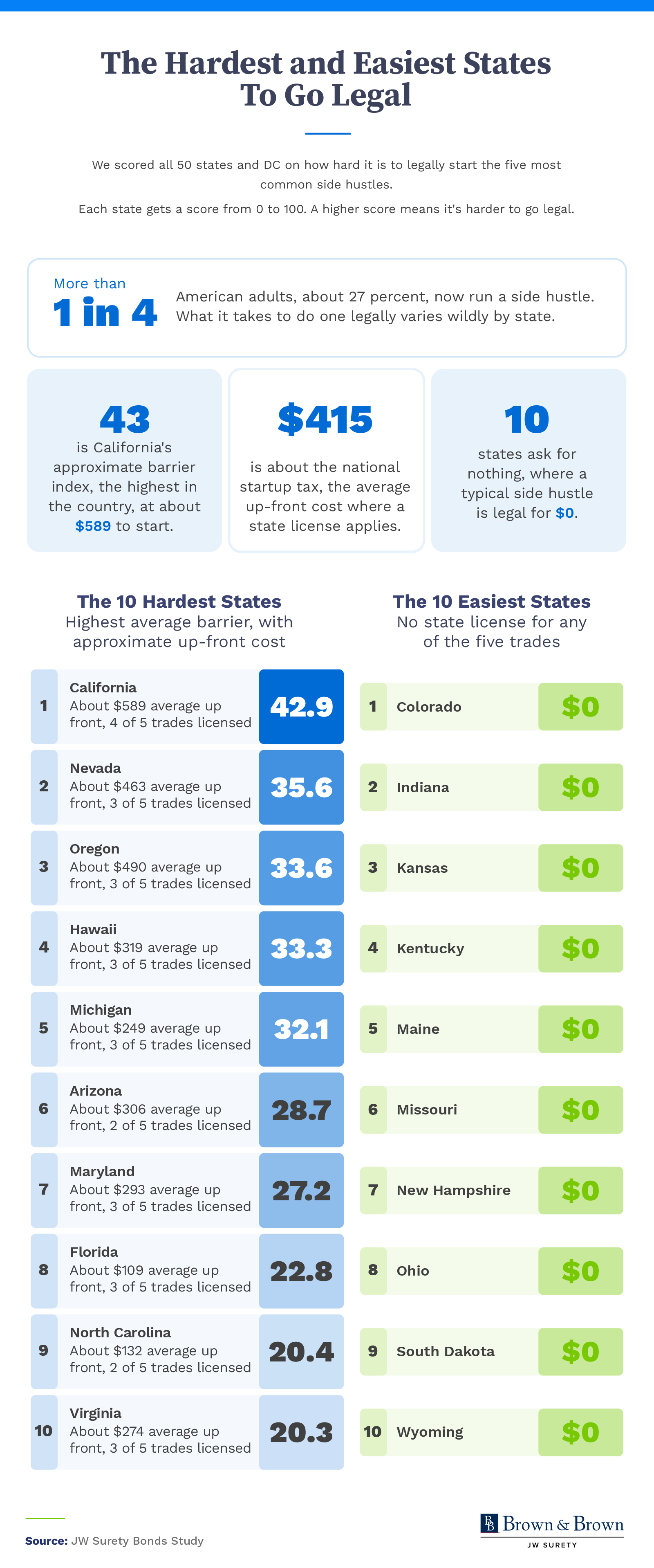
California, Nevada, and Oregon topped the index as the hardest states to launch a side hustle. The hardest states aren't always the ones with the single priciest requirement, though. California ranked first overall, yet the most expensive individual path in the country was Nevada's handyman requirement at about $1,255, in the second-ranked state. A typical California path ran closer to $589.
At the other end, 10 states ask for nothing at all to start these trades: Colorado, Indiana, Kansas, Kentucky, Maine, Missouri, New Hampshire, Ohio, South Dakota, and Wyoming. No state regulates all five state-licensed trades; even California and Connecticut stop at four, and the most common pattern, in 19 of 51 jurisdictions, is licensing just two. Between a $0 state and a roughly $589 California path, where you live often decides the bill more than what you do.
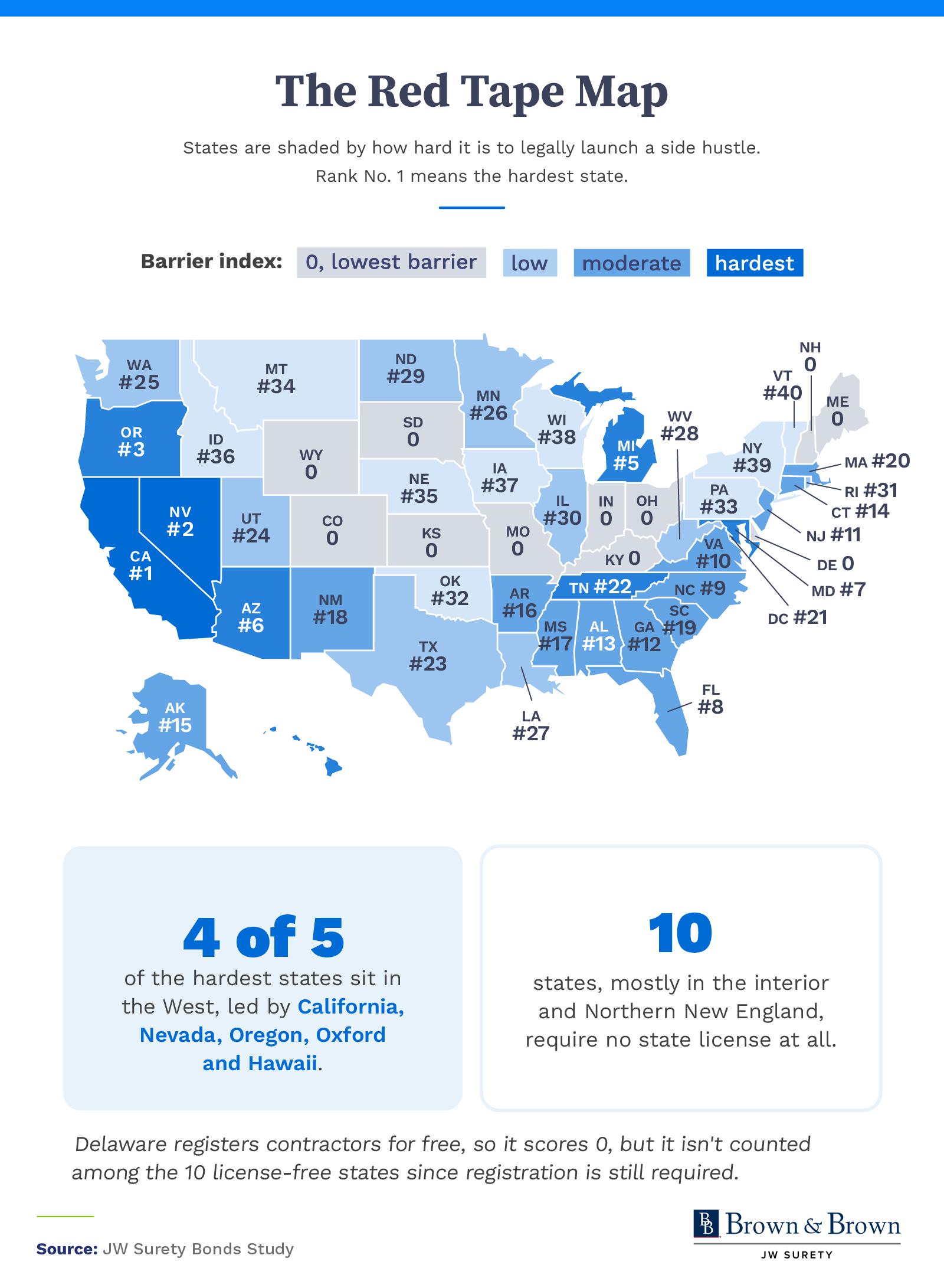
Getting started legally costs about $236 on average in the West, roughly $138 across the South, and just $47 in the Midwest, which holds half of the country's license-free states. That regional split is why two operators in the same trade can face startup costs that differ by hundreds of dollars.
Which Side Hustles Put Up the Steepest Barriers
Some trades are hard to afford, others are hard to qualify for, and the two don't always overlap.
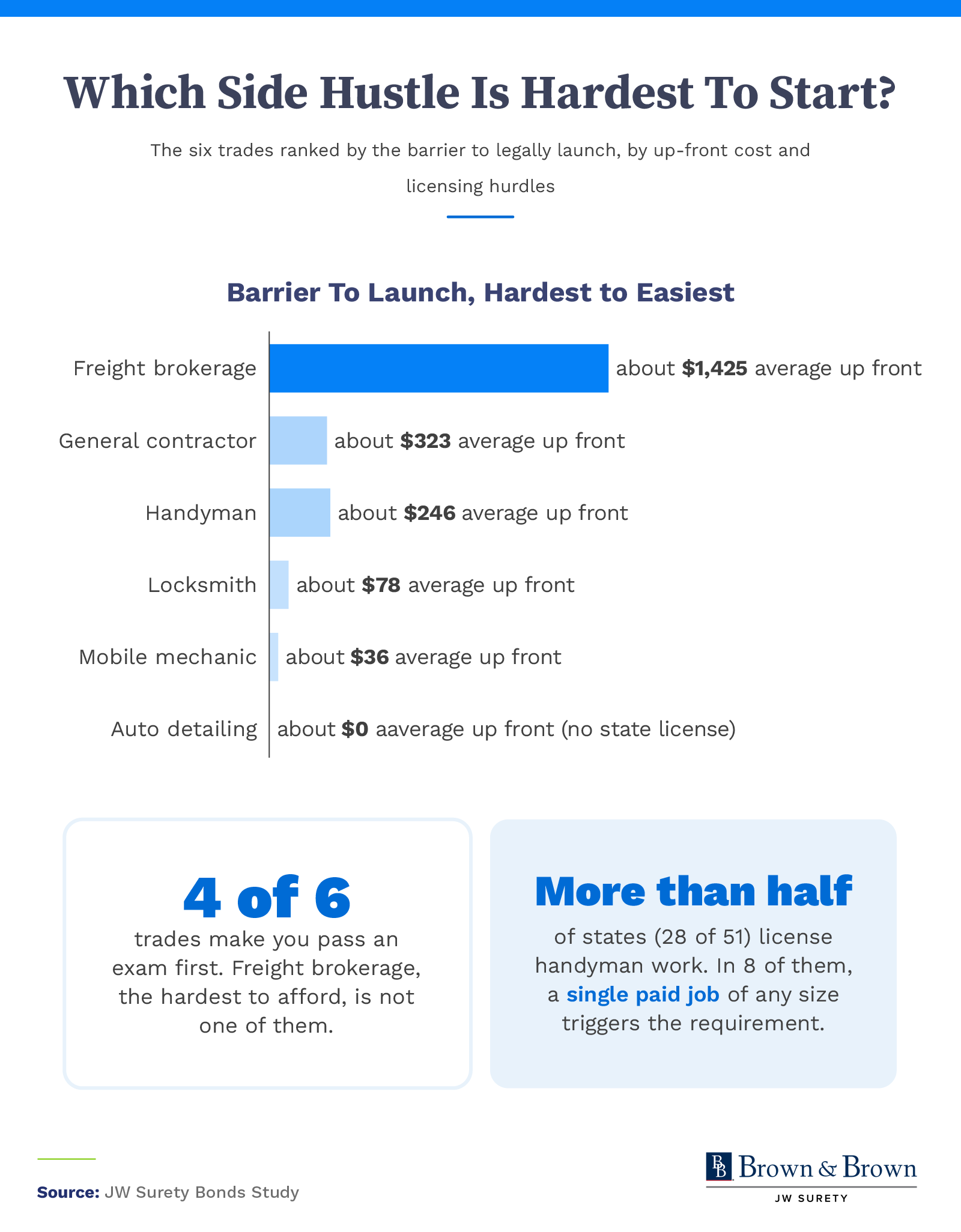
Freight brokerage was the priciest trade to enter, yet one of the simplest to qualify for. It topped the cost ranking on the strength of its federal bond alone and asks for no exam, no experience, and no continuing education. General contracting was at the opposite end of the effort scale: 22 of the 36 states that license contractors, about 61%, also require passing an exam, the widest testing gate of any trade.
The idea of the unlicensed handyman is largely a myth. Handyman work needs a state license in 28 states, and in eight of them, a job of any size triggers the requirement. Locksmiths, meanwhile, are screened more than they're tested: 11 of the 12 states that license the trade require a background check, while only seven require an exam.
The Bonds Hiding Behind a Simple Side Gig
Surety bonds turn up in more of these trades than most first-time operators expect, and they're overwhelmingly a construction story.
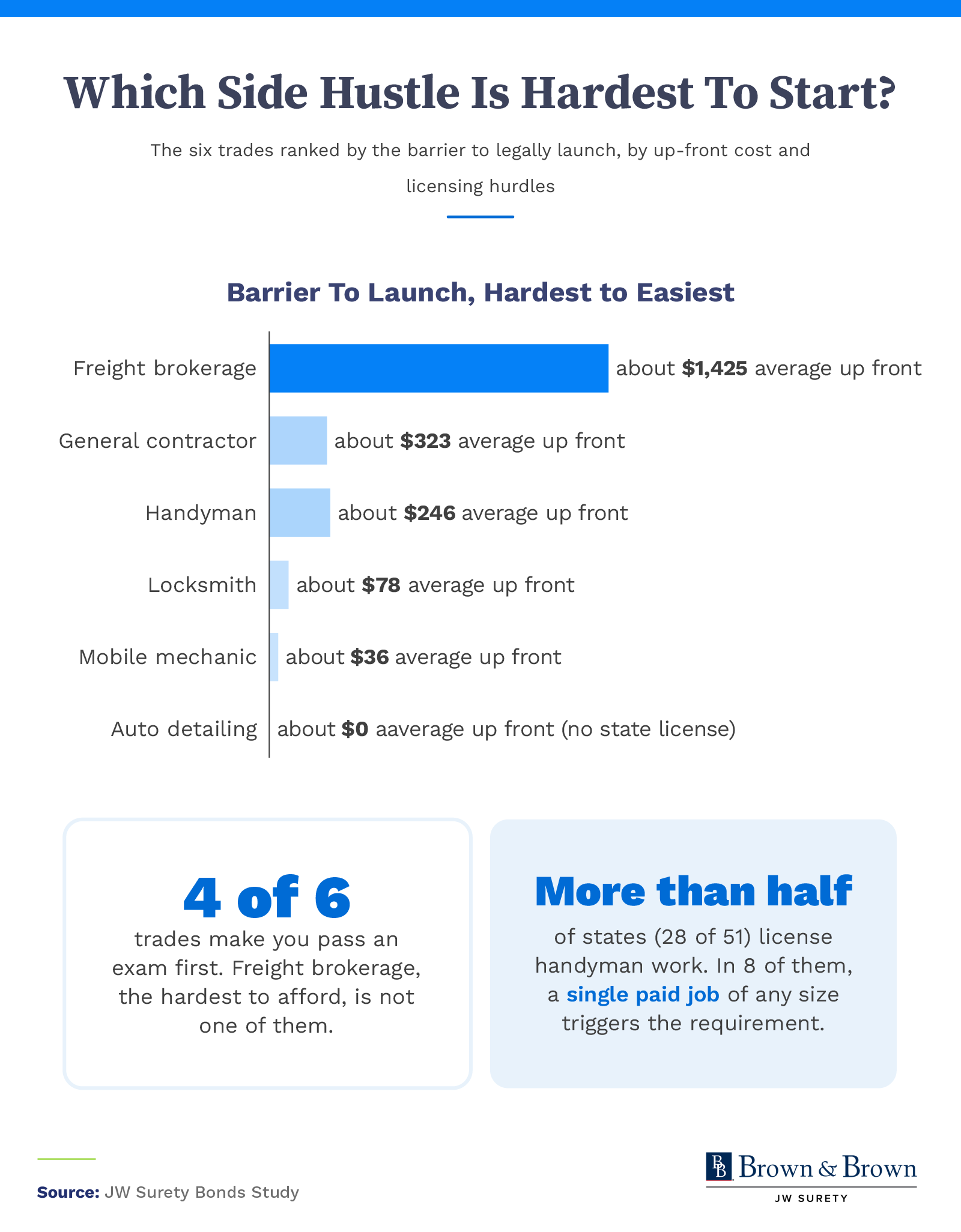
casual trades carried real bonds: handyman work requires a surety bond in 11 states, ranging from $1,000 to $25,000, and Washington carries the largest residential contractor bond at $30,000.
Freight brokerage is in a category of its own. Its $75,000 federal bond, required under the FMCSA financial responsibility rule before a broker can operate, is the largest bond in the study's standard scenario. Operators don't pay that full amount; they pay a premium, about $1,125 a year at a standard rate, though brokers with weaker credit can pay several times that. Oregon's commercial contractor bond can reach $80,000 in scenarios outside the study's scope.
The Costs That Outlast Your First Day
Getting licensed is a one-time hurdle; staying licensed is a recurring one.
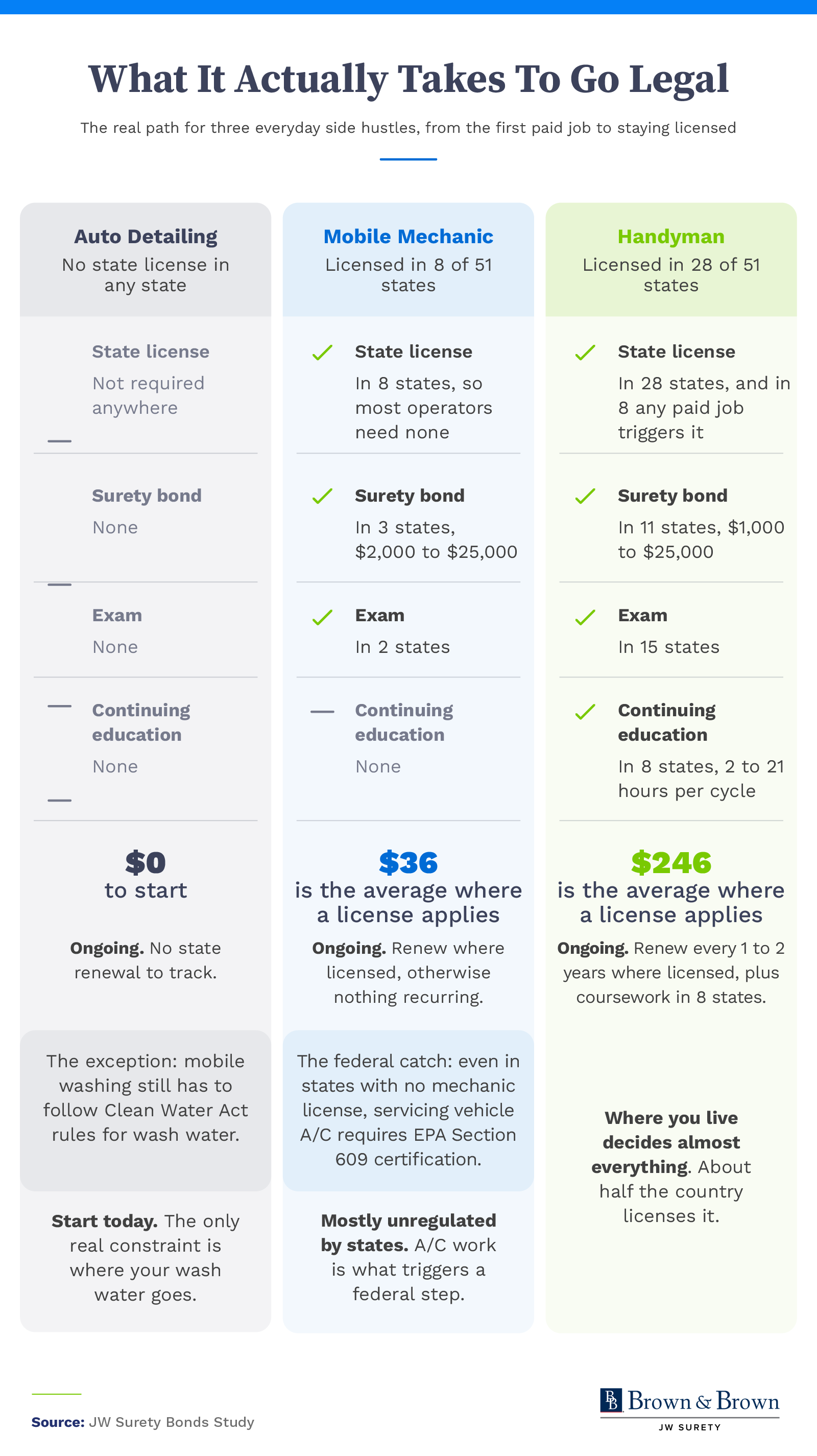
The path to legally starting a side hustle depends on the trade as much as the state. Auto detailing is free to start anywhere, handyman work is licensed in 28 states, and mobile mechanic work in just eight. For handyman work, the trigger is often the very first job: in eight of the 28 licensing states, there's no dollar threshold, so even a small paid repair already requires a license.
The sticker price is only the first payment. Handyman and contractor licenses renew every one to two years and add continuing education in eight and 13 states respectively, so licensed contractors and handymen repeat 2 to 21 hours of coursework each renewal cycle. A federal layer is easy to miss, too: mobile air conditioning service requires EPA Section 609 certification, and mobile auto detailing falls under Clean Water Act wash-water rules, even though neither trade needs a state license.
The Costs That Outlast Your First Day
For most of these side hustles, the paperwork is a bigger hurdle than the work itself, and how much of it you face comes down largely to your ZIP code. If you're weighing a side business, it pays to check your own state's licensing board before you count on a certain startup cost, since a neighboring state's rules may look nothing like yours. And remember that going legal rarely ends at launch: renewals, continuing education, and bond premiums all add to the real price of staying in business.
Methodology
Overview
Permission to Hustle is a 50-state index of what it takes to legally launch six common side businesses, scored as of June 22, 2026. Licensing is associated with a state and a trade, the index measures requirements and does not judge the work or claim why states differ. It is a sourced census, not a poll, so there is no sample and no margin of error.
Scenario and scope
Each of the five state-variable trades is scored against a fixed solo-operator scenario, a mobile auto detailer, a mobile general repair mechanic, a handyman taking a $5,000 repair, a lockout and rekey locksmith, and a general contractor taking a $50,000 residential remodel, while freight brokerage is federal and identical everywhere and is entered once as a national baseline.
Up-front cost calculation
Up-front cost per state and trade sums the application fee, license fee, an estimated bond premium at a flat 1.5 percent of face, the operator pays the premium not the face, exam fee, exam prep and background-check fee, then is min-max scaled to a 0 to 100 range across the 255 state-variable cells.
Complexity score calculation
The complexity score, also 0 to 100, blends exam (35), experience (30, scaled by years over four and capped at one), background check (20), and continuing education (15).
Barrier score
The barrier score per state and trade is 0.55 times up front plus 0.45 times complexity. Processing time, published by only a handful of states and unknown for about 95 percent of cells, is given weight 0 and reported descriptively rather than scored. The state index is the mean barrier across the five trades for each jurisdiction, and the trade index is the mean barrier across jurisdictions for each trade, with freight on the same scale.
Sources of record
Official state licensing boards and statutes are the value of record, with the federal freight row from the FMCSA financial responsibility rule and the $75,000 bond set at 49 CFR 387.307, stricter enforcement effective January 16, 2026. Worked examples include the California Contractors State License Board, the California Bureau of Automotive Repair, the California Bureau of Security and Investigative Services and the federal EPA Section 609 certification.
Supporting data sources
Side-hustle prevalence comes from the Bankrate Side Hustle Survey, the formation backdrop from Census Business Formation Statistics and the FRED business application series, and the prior benchmark from the Institute for Justice License to Work. Aggregators were used only to locate boards, never as the value of record, and every cell carries a verbatim source quote and access date.
Coverage and sensitivity testing
Coverage is all 50 states and D.C. across the five state-variable trades, plus the single federal freight baseline. Under up front-weight shifts of plus or minus 10 points, from 0.45 to 0.65, the five hardest states hold completely and the top 10 holds with a worst case of 8 of 10.
Limitations
Three study limitations include:
- State requirements only. The index counts state requirements only. Many mobile trades also need a local city or county business license that is noted but not enumerated, so a state score of zero is not zero cost on the ground.
- Dollar figures are estimates. The dollar layer is softer than the counts. The highest up front, the roughly $415 national startup tax, and the per-state averages include estimated exam-prep costs and a few unverified application versus license fee splits, so they are presented as approximate, while the rankings and the licensing, exam, and bond counts are firm.
- Delaware's edge case. Delaware registers contractors with no dollar threshold under 19 Del. C. Chapter 36, so it is counted as licensed rather than license-free even though its registration carries no captured fee and it scores near zero.
Recent or pending changes are flagged in the data, including California's $1,000 contractor threshold effective 2025 and Maine licensing beginning January 2027.
About JW Surety Bonds
JW Surety Bonds is among the nation's leading surety bond providers, supporting contractors, trade professionals, and small business owners in staying compliant and protected. From construction bonds to electrical contractor bonds, our team simplifies federal and state requirements so you can focus on growing your business.
Fair Use Statement
Information from this article may be shared for noncommercial purposes only. Please include a link with proper attribution to JW Surety Bonds when citing or referencing this content.

Leave a Reply