


Most advice for new business owners sounds the same: get licensed, get insured, and look professional enough that customers trust you. What that advice leaves out is how much trust costs up front. We analyzed the real price of becoming a legitimate business across eight regulated trades and all 51 U.S. jurisdictions, adding up license and exam fees, business registration, surety bonds, and first-year insurance. The numbers showed that founders often spend four figures clearing compliance hurdles before a single customer walks through the door.
Key Takeaways
-
The price of looking legit: founders pay about $324 in government fees before their first customer, roughly $1,300 all-in..
-
Nevada has the highest government fees for new trade businesses, nearly 8 times Indiana's.
-
Indiana is the cheapest state to look legit. Founders there pay just $131 in government fees to start.
-
Poor credit can make bonding 10 times more expensive for new founders ($2,500 instead of $250 on a $25,000 bond).
-
Even before the first customer, HVAC and massage therapy are the most expensive trades to legitimize (it costs about $1,400).
-
Cosmetology training can cost the average worker about $39,000 in lost wages before their first paycheck.
Why Insurance Outweighs Fees for New Trade Owners
When people picture the cost of starting a business, they usually think about license fees and paperwork. The bigger expense tends to be less obvious.
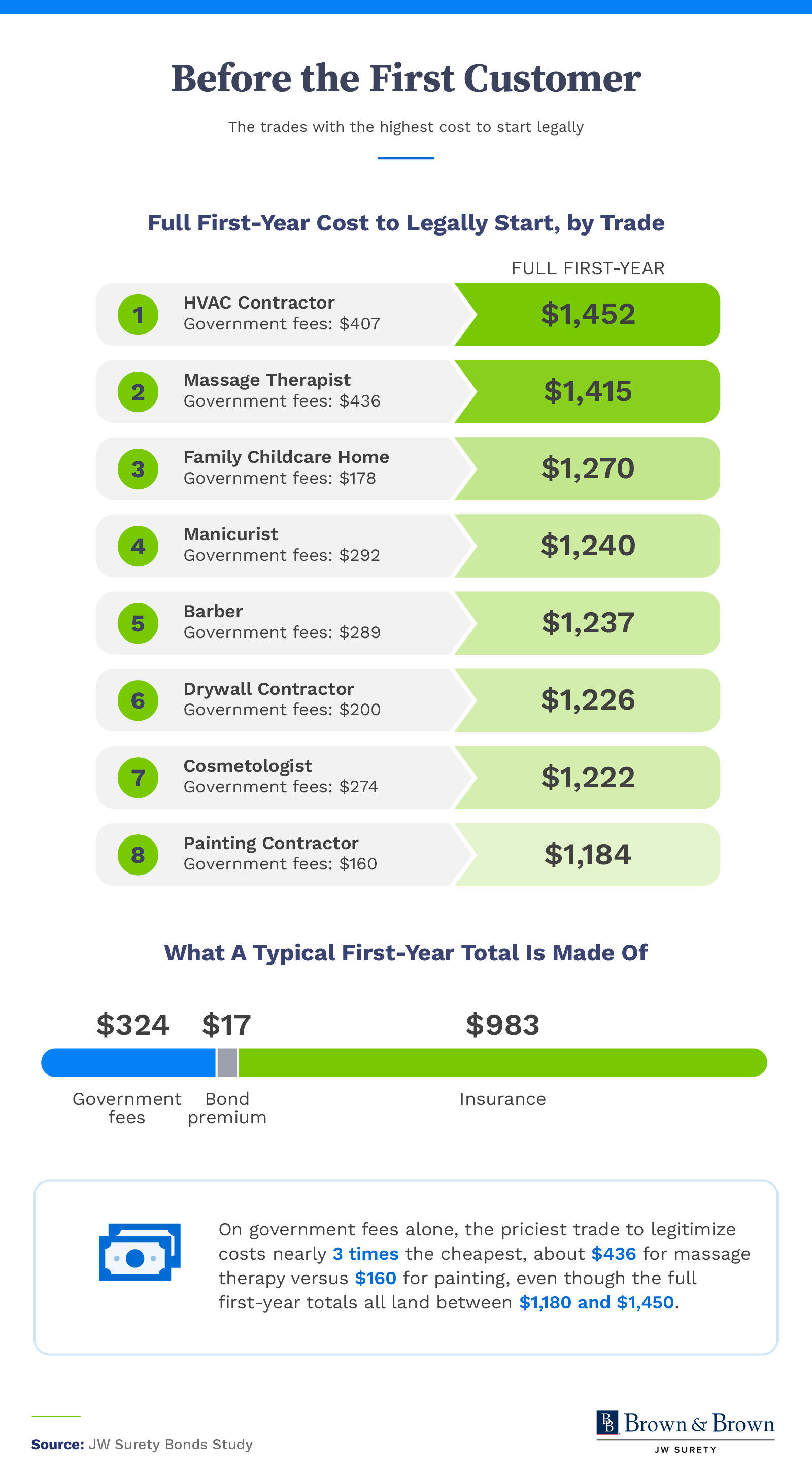
First-year insurance, not government fees, made up the bulk of every trade's total cost, and it barely changed from one trade to the next. Premiums didn't vary much; they were about $948 to $1,092 a year, and the priciest trade ran just 1.2 times the cheapest. Insurance drives most of the cost. The trade a founder chose mattered far less to the bottom line than one might expect.
Family childcare was a good example of that gap. Providers paid one of the smallest hard fees of any trade, about $178, yet they still ranked third on total first-year cost. The reason was insurance: home-based liability coverage ran highest of any trade at roughly $1,092 a year.
Cosmetologists showed the same pattern from a different angle. Among the trades licensed in all 51 jurisdictions, they paid the smallest hard fee at $274, but they carried the highest training requirement by far at about 342 days. That time is money, even when the paperwork is cheap.
How State Lines Change the Cost of Starting Up
Two founders in the same trade can face very different bills depending on which state they register in.
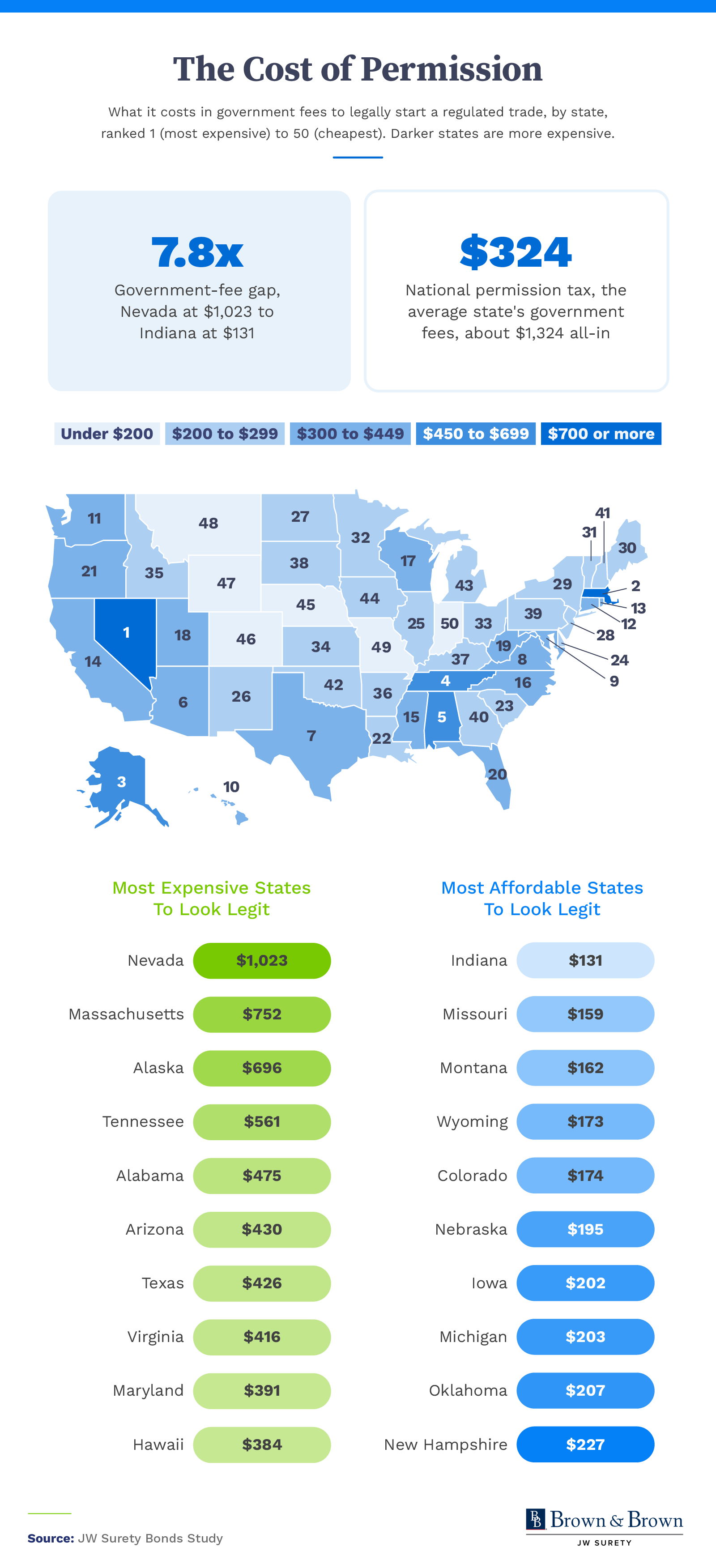
Most states clustered tightly on government fees. All but five came in under $450, which meant the handful at the top were genuine outliers rather than the high end of a smooth climb. For most founders, the fees were similar wherever they set up.
Nevada was at the most expensive end, almost entirely due to registration rather than licensing. Setting up a business there cost $425 across three mandatory filings before any trade license costs. That made simply registering the company more expensive in Nevada than the full government bill in many other states.
Once we counted everything, first-year insurance was nearly the same nationwide; the gap between the priciest and cheapest state shrank to about 1.8 times when bonds and insurance were included. Even so, starting legally cost four figures almost everywhere, with the cheapest states still reaching about $1,100 all-in.
Where Credit and Bonds Raise the Stake
The same requirements cost several times more for some founders, and the reasons had little to do with their chosen trades.
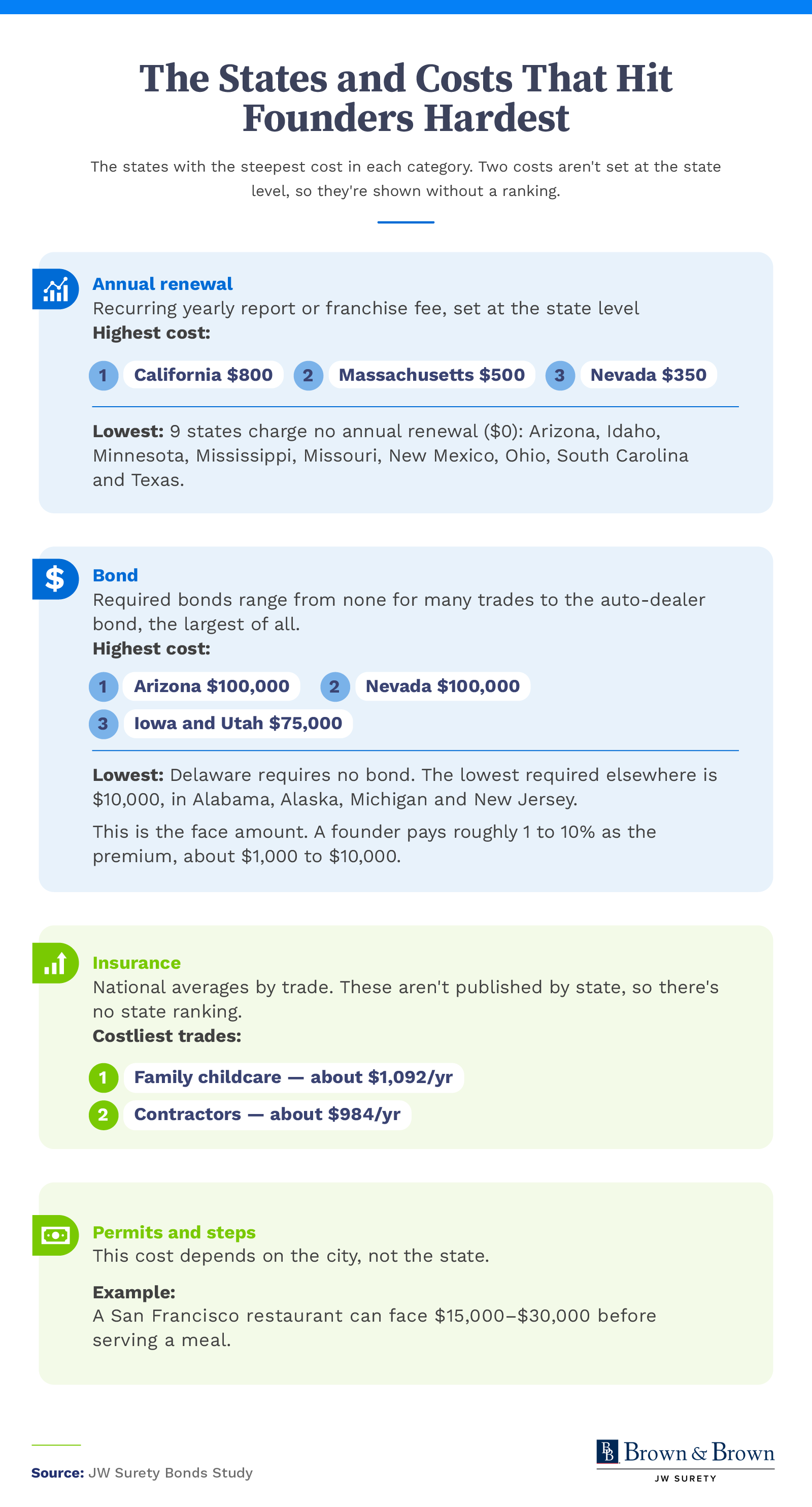
Credit showed the sharpest divide. On a $25,000 bond, a founder with strong credit would have paid about $250, while a founder with poor credit would have paid roughly $2,500 for the exact same coverage. That $2,250 gap had nothing to do with the business itself and everything to do with the owner's credit history.
Recurring costs added another layer. California's $800 annual franchise fee was the steepest in the country, and on its own, it more than doubled the average state's entire first-year government bill of $324. For founders there, the cost of looking legit did not end after year one.
Bond requirements varied widely by trade. Many personal-care trades required no bond at all, while auto dealers faced a $100,000 face amount (with a premium of 1% to 10%). The bond is never paid in full up front, but the premium on a large bond can still be a big early expense.
Nevada was the toughest state on every front. It topped the country in government fees, tied for the largest required bond, and carried the longest average training time. For founders deciding where to start, this one might be among the most expensive states to legitimize a business, no matter which cost you look at.
The Real Starting Line
Starting a business is still within reach for most people, but the real starting cost runs higher and less visible than most budgets assume. Fees get the attention, while insurance and bonding usually drive the bill, and a founder's credit can swing bond pricing by thousands of dollars. Knowing those numbers in advance turns a stressful surprise into a line item you can plan around. The price of looking legit is real, and it is much easier to manage when you can see it coming.
Methodology
Scope: Each trade is priced across all 51 jurisdictions, the 50 states, and the District of Columbia. Nothing is imputed, and any missing or board-set value is flagged.
Ranking metric: States and trades are ranked on government fees only, the Institute for Justice License to Work (3rd ed.) license and exam fees plus the state LLC registration fee from LLC University, with registration cross-checked against primary Secretary of State filings in eight states. Per-trade figures use the median across all 51 jurisdictions. The state ranking uses the mean government fee across the eight comparable trades for each of the 50 states, with the District of Columbia excluded because it is not a state.
Realistic first-year cost: Two clearly labeled estimates are added to the government fee, a good-credit surety bond premium at 1% of the bond face (10% for poor credit, with bond data from JW Surety Bonds and state boards), and a typical first-year insurance premium from Insureon and The Hartford. The bond face amount is never added to any cash total because a founder pays only the premium. Insurance uses the most conservative defensible basis per trade (for example, home-based general liability for family childcare rather than a daycare-center policy).
Comparable trades: The eight are cosmetologist, barber, manicurist, massage therapist, HVAC contractor, painting contractor, drywall contractor, and family childcare home. Auto dealers and electricians are sourced differently and were held out of the ranking. We also checked the wider Institute for Justice occupation set for the bonded trades a surety audience would expect, such as plumbing, roofing, general contracting, and electrical. The Institute does not track those trades, so the verifiable set is these eight.
Wages and income: Wages are from BLS Occupational Employment and Wage Statistics (May 2023, state level where published and national where not). State median household income is from the Census American Community Survey 2024 one-year data. Lost wages are calculated as (IJ training days ÷ 365) × the BLS national mean annual wage for the occupation.
Verification: License fees and training days were reconciled against the official Institute for Justice License to Work (3rd ed.) report and matched exactly. State median household income was confirmed against the U.S. Census Bureau API.
About JW Surety Bonds
JW Surety Bonds is among the nation's leading surety bond providers, supporting contractors, trade professionals, and small business owners in staying compliant and protected. From construction bonds to electrical contractor bonds, our team simplifies federal and state requirements so you can focus on growing your business.
Fair Use Statement
Information from this article may be shared for noncommercial purposes only. Please include a link with proper attribution to JW Surety Bonds when citing or referencing this content.

Leave a Reply