

Today's customers often form opinions about contractors before the first conversation even happens. JW Surety Bonds surveyed over 1,000 U.S. consumers to find out what influences their hiring decisions. We explored which trust signals matter, where customers get information, and why bad experiences still happen when people do their homework. Learn what customers care about now and how contractors can use those insights to build trust, reduce hesitation, and win more work.
Key Takeaways
- 31% of consumers have had a bad experience with a contractor, such as being scammed, overcharged, or receiving poor work, even after they checked reviews or credentials.
- 33% of consumers who use social media say Facebook leads them to the best quality contractors, followed by Reddit (20%) and Nextdoor (17%).
- Over 1 in 3 consumers (35%) say knowing a contractor is bonded would strongly influence their decision to hire them.
- 69% of consumers say a 4-star review rating is the lowest they would accept when hiring a contractor.
- Insurance (80%), a valid license (52%), and a surety bond (46%) are the top factors that make consumers feel more protected.
Bonding and Insurance Influence Hiring Decisions
Consumer protection plays a role in hiring decisions, but many people still misunderstand what bonded and insured mean. These credentials build trust, but gaps in knowledge can keep customers from asking the right questions or fully understanding the protection they want.
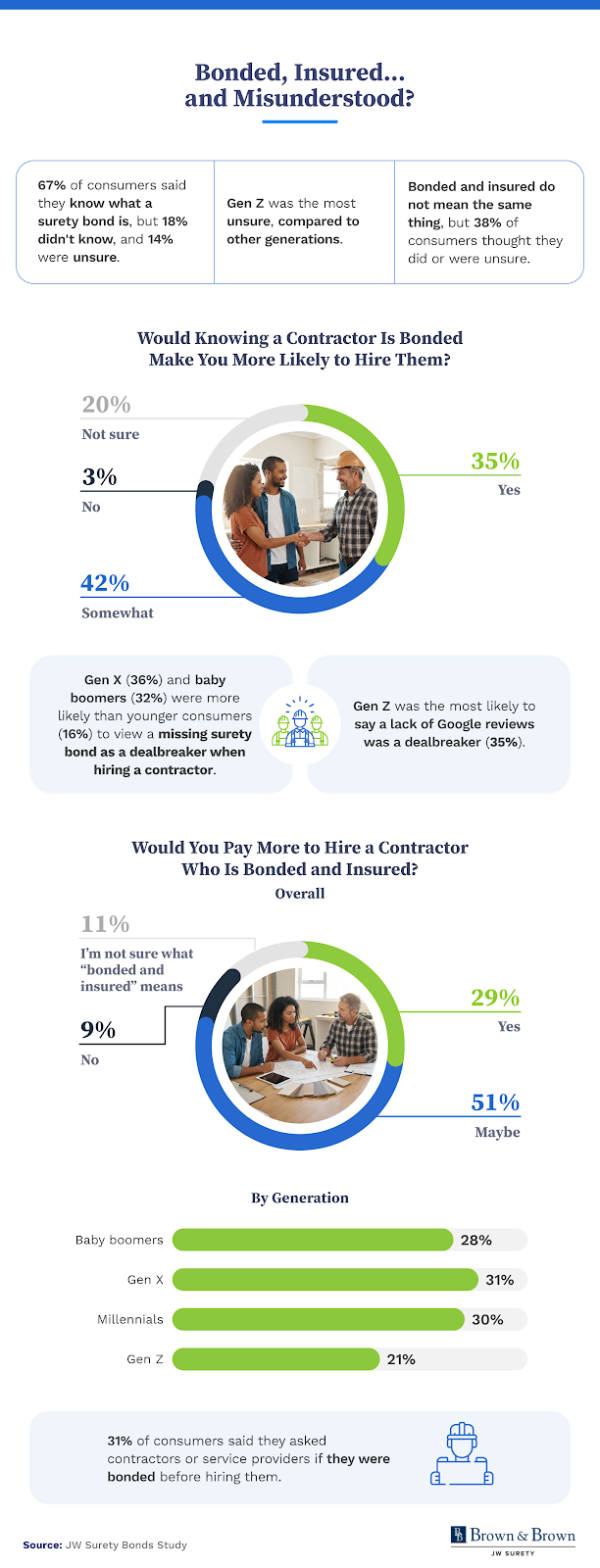
Two-thirds of consumers (67%) said they know what a surety bond is. Another 18% said they do not know, and 14% were unsure of its exact meaning. Gen Z was the most unsure about what "bonded" means and the least likely to ask about bonding before hiring. Older consumers (baby boomers and Gen X) were most likely to say a missing surety bond is a dealbreaker when hiring a service provider.
Confusion between "bonded" and "insured" was common. Insurance typically covers accidents or damage, while a surety bond protects the customer if a contractor fails to meet legal or contractual obligations. More than one-third of respondents (38%) either believed the two meant the same thing or were unsure of the difference.
When consumer protection is clearly understood, it adds measurable value and confidence in who consumers are hiring. Over 1 in 3 consumers (35%) said knowing a contractor was bonded would strongly influence their hiring decision. Nearly one-third (31%) said they have asked whether a contractor was bonded before hiring, and 29% said they would be willing to pay more for a contractor who is both bonded and insured.
Consumers Are Rethinking Who They Trust and Why
When consumers decide who to hire, formal credentials still carry more weight than online popularity. Licenses, insurance, and bonds inspire more trust than social media presence.
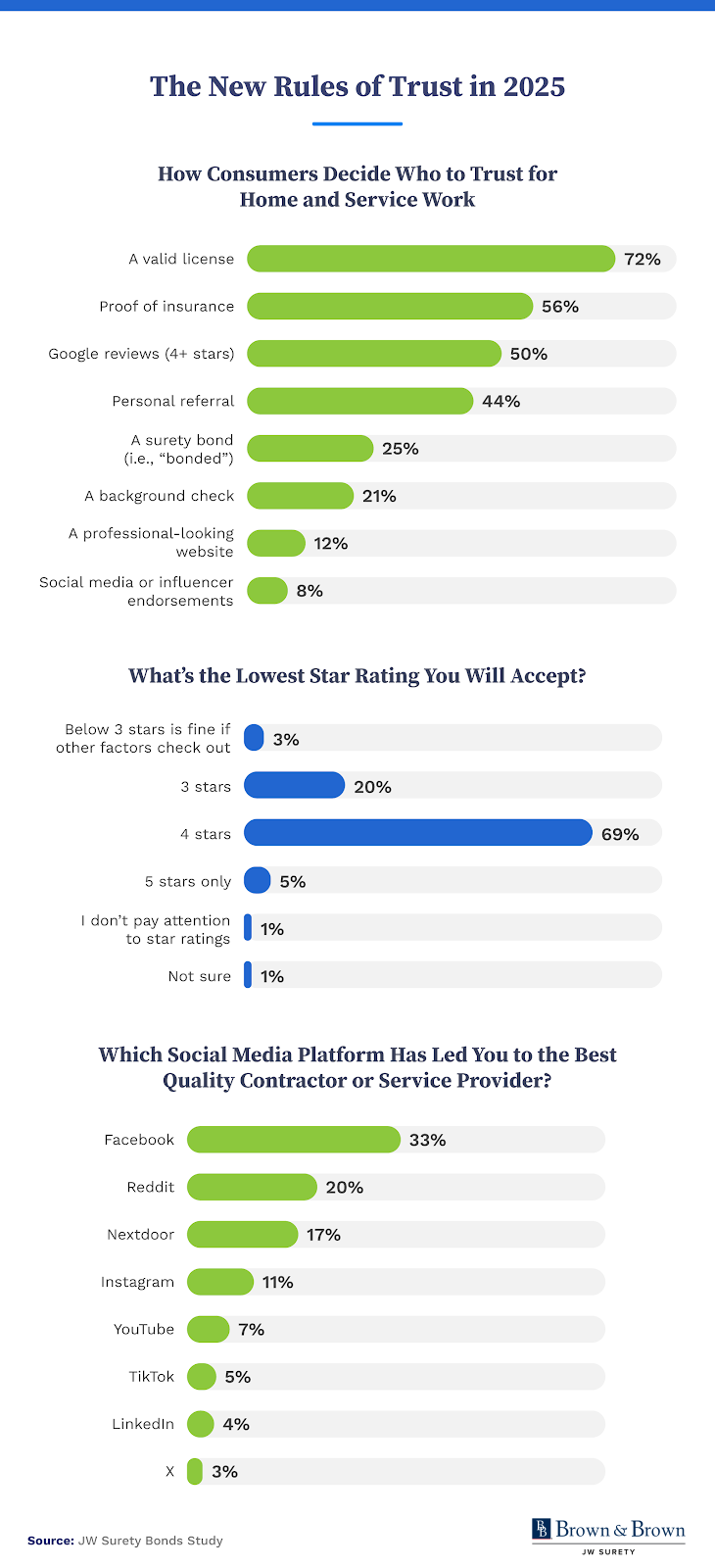
A valid license was the strongest trust signal, cited by 72% of consumers, followed by proof of insurance at 56%. Another 25% of consumers said a surety bond would increase their trust when hiring a contractor. These safeguards ranked much higher than social media or influencer endorsements (8%). Among those who use social platforms to find contractors, 33% said Facebook led them to the best-quality providers. Reddit followed at 20%, and Nextdoor at 17%.
Online reviews remained a major gatekeeper in the hiring process. Most consumers set a clear quality threshold, with 69% saying a 4-star rating is the lowest they would accept. For service providers, this means strong reviews and social presence can attract attention, but licenses, insurance, and bonding are what give consumers the confidence to move forward.
Perception of Safety Does Not Always Match Actual Legal or Financial Protection
Many consumers believe they are protected because a contractor appears trustworthy or well-reviewed, yet the data shows those signals often fail when problems arise. The gap between perceived safety and real protection helps explain why negative experiences still happen.
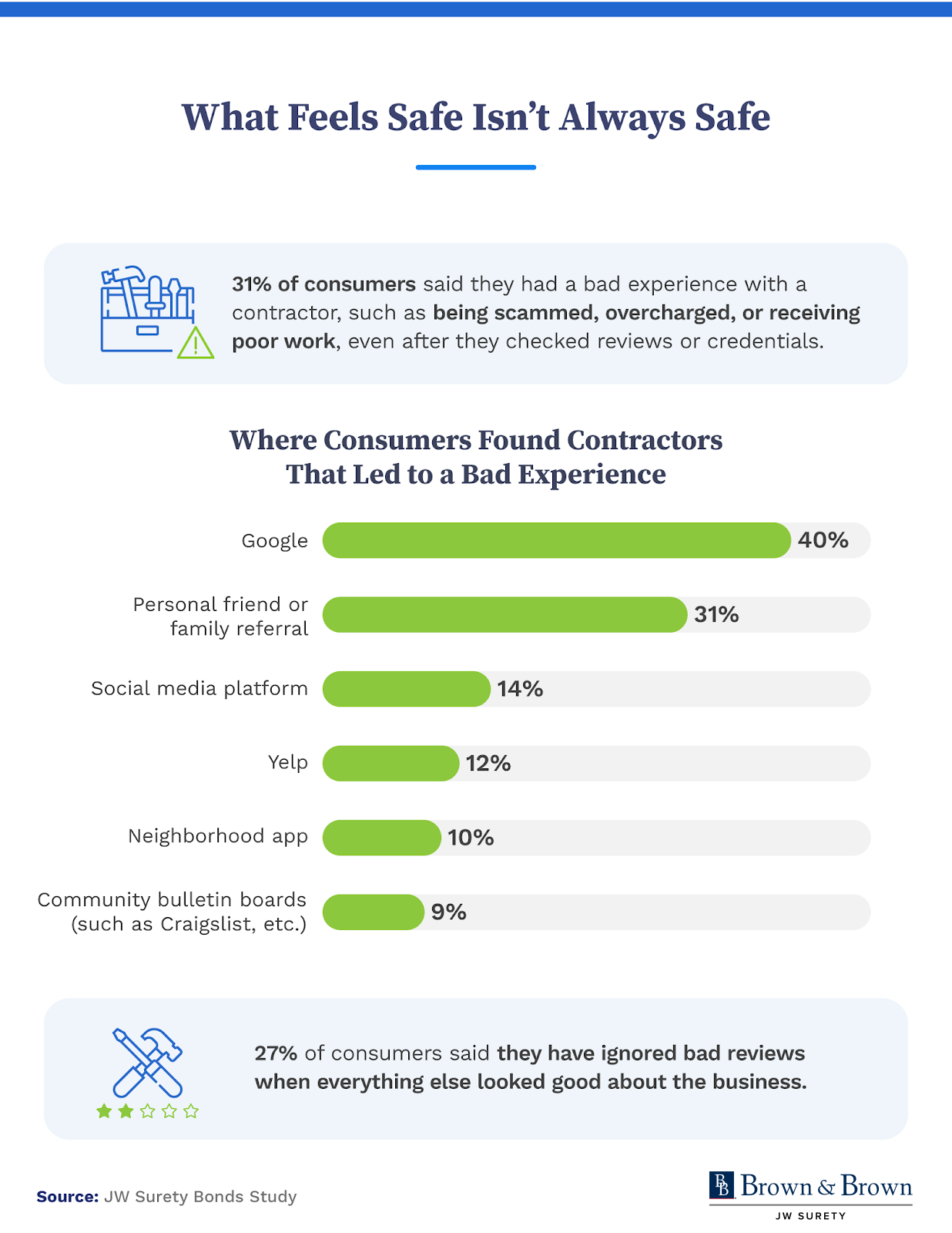
Even though they checked reviews or credentials, 31% of consumers had a bad experience with a contractor, including being scammed, overcharged, or receiving poor-quality work. Google was the most common source tied to bad hires at 40%, followed by personal referrals at 31%. Social media ranked next overall at 14%, with negative experiences linked most often to:
- Facebook (50%)
- Instagram (18%)
- TikTok (11%)
Some consumers acknowledged that they had ignored warning signs during the hiring process. More than one-quarter (27%) said they overlooked a bad review when other factors felt reassuring. Those factors, in order of importance, included:
- A friend's recommendation
- Appearing trustworthy in person
- Low pricing
- A professional website
- Being the only available option
- Having a strong social media presence
When asked which factors would make them feel more protected if something went wrong, consumers most often said insurance (80%), followed by a valid license (52%) and a surety bond (46%). Others said online reviews (20%) and personal referrals (18%), even though neither offers a real way to recover losses.
What Trust Looks Like to Consumers in 2026
For contractors, this study shows that trust is built before the first conversation. While reviews and social platforms help customers find you, licenses, insurance, and bonding are what give them the confidence to hire. Many consumers still misunderstand these protections, which creates hesitation and missed opportunities. Clearly explaining your credentials in plain language can set you apart, reduce friction, and help customers choose you with confidence.
Methodology
We surveyed 1,001 U.S. adults to understand how consumers vet service providers, what trust signals they rely on, and how perceptions of protection shape hiring decisions. The survey explored how consumers evaluate trust when hiring service providers, including their awareness of formal credentials, reliance on social media and reviews, and experiences with trust signals that failed to prevent bad outcomes.
The average age of respondents was 41. The gender breakdown was 50% women, 50% men, and less than 1% nonbinary. Generationally, 9% were baby boomers, 25% were Gen X, 48% were millennials, and 17% were Gen Z. Less than 1% were from the Silent Generation and were excluded from the generational breakdowns due to limited sample size. The data was collected in December 2025.
About JW Surety Bonds
JW Surety Bonds helps contractors and professionals across the U.S. meet bonding requirements and build credibility with customers. By offering fast, affordable access to surety bonds and business insurance, we support businesses that want to operate transparently and earn trust in regulated industries.
Fair Use Statement
The information in this article may be used for noncommercial purposes only. If shared, please include proper attribution with a link back to JW Surety Bonds.

Leave a Reply