
Hiring someone to repair your home often requires a significant amount of trust, but homeowners may not always take steps that could help them avoid costly mistakes. To see where concerns about contractor scams were highest, we analyzed Google search interest for contractor fraud, licensing, and scam-related terms across all 50 states, the District of Columbia, and major U.S. cities. We also surveyed 1,004 U.S. homeowners about how they vet contractors, recognize red flags, handle financial losses, and use AI during the home repair process.
Key Takeaways
- California is America's hotspot for contractor scams, with the nation's highest search interest in contractor fraud (913.2 searches per 100,000 residents).
- Sacramento, San Francisco, and San Jose have the highest search interest in contractor scams per capita.
- 61% of homeowners are confident they could spot a contractor scam, yet only 22% checked a license before their most recent hire.
- 51% of homeowners would knowingly hire an unlicensed contractor to save money.
- 38% of homeowners have lost money to a contractor, with a median loss of $2,000; 15% lost $10,000 or more.
- 60% of contractor scam victims never recovered any of the money they lost.
California Cities Lead Contractor Scam Searches
Homeowners' interest in contractor scams varied considerably depending on where they lived. Some cities stood out for particularly high search volumes related to fraud, complaints, licensing, and other contractor concerns.
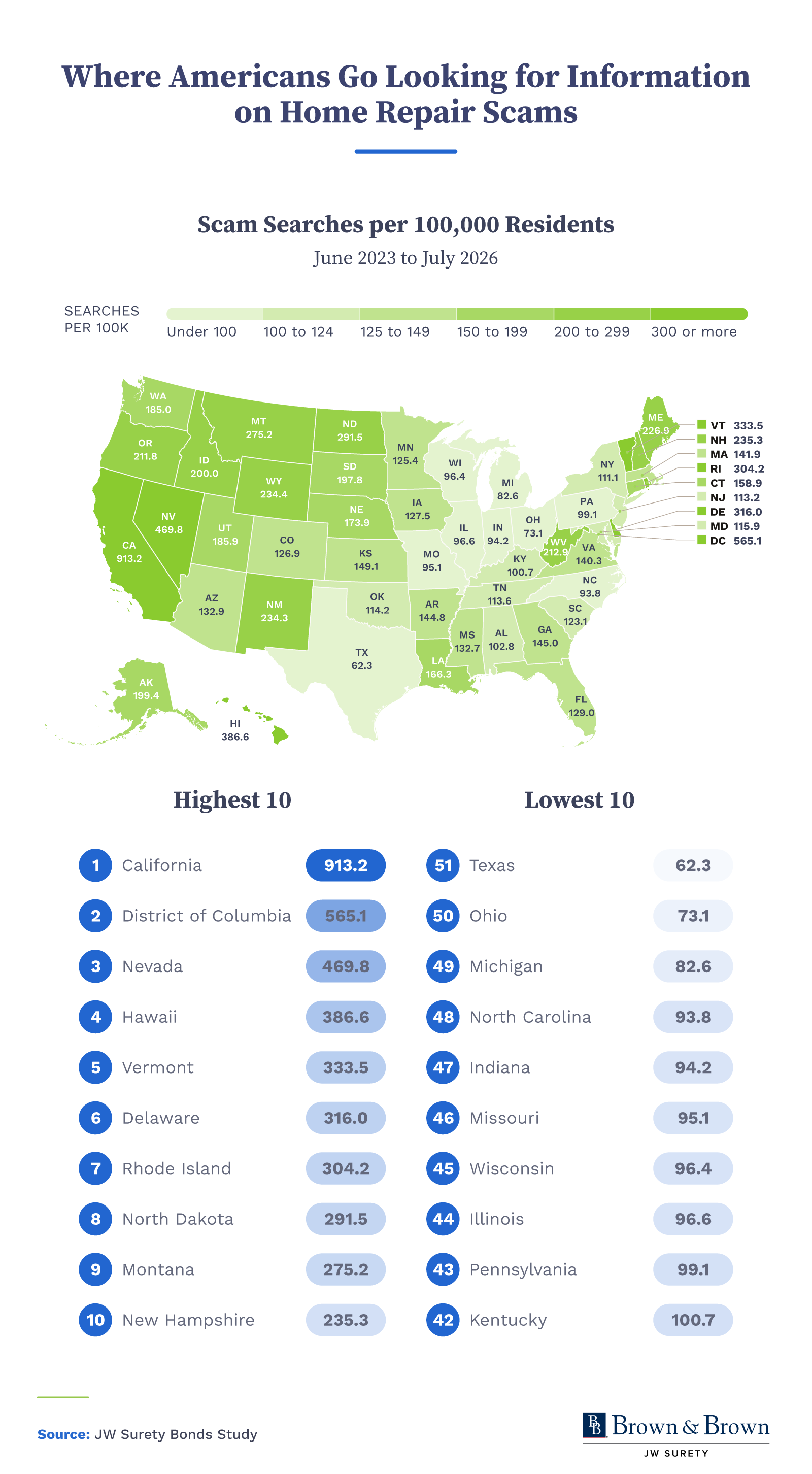
California was America's contractor scam hotspot, with the nation's highest search interest in contractor fraud. Its cities also dominated the rankings: Sacramento had the highest search interest at 2,108.3 searches per 100,000 residents, followed by San Francisco at 1,532.5 and San Jose at 1,486.1. Las Vegas ranked fourth at 1,443.0, followed by San Diego at 1,341.3.
California cities occupied nine of the top 11 spots overall. Oakland (1,259.0), Fresno (1,252.8), Long Beach (1,163.2), Bakersfield (1,134.6), and Los Angeles (1,065.6) all ranked among the cities with the highest search interest. Miami, the only other non-Californian city to break into the top 11, recorded 1,114.7 searches per 100,000 residents.
The top 20 cities where Americans most often went looking for information on home repair scams were:
- Sacramento, CA — 2,108.3
- San Francisco, CA — 1,532.5
- San Jose, CA — 1,486.1
- Las Vegas, NV — 1,443.0
- San Diego, CA — 1,341.3
- Oakland, CA — 1,259.0
- Fresno, CA — 1,252.8
- Long Beach, CA — 1,163.2
- Bakersfield, CA — 1,134.6
- Miami, FL — 1,114.7
- Los Angeles, CA — 1,065.6
- Atlanta, GA — 939.3
- Tampa, FL — 921.3
- Minneapolis, MN — 906.3
- Seattle, WA — 722.5
- Baltimore, MD — 696.5
- Portland, OR — 653.4
- Raleigh, NC — 639.9
- Denver, CO — 600.9
- Virginia Beach, VA — 599.5
At the other end of the ranking, New York had the lowest search interest at 133.0 per 100,000 residents. The following were the 20 cities with the lowest search interest in contractor scams:
- New York, NY — 133.0
- Houston, TX — 216.1
- Chicago, IL — 217.1
- San Antonio, TX — 229.9
- El Paso, TX — 266.5
- Fort Worth, TX — 284.0
- Philadelphia, PA — 317.6
- Phoenix, AZ — 317.6
- Dallas, TX — 326.4
- Columbus, OH — 342.1
- Indianapolis, IN — 345.1
- Memphis, TN — 349.4
- Louisville, KY — 355.2
- Oklahoma City, OK — 359.8
- Jacksonville, FL — 362.6
- Milwaukee, WI — 393.0
- Tulsa, OK — 401.2
- Austin, TX — 409.9
- Mesa, AZ — 412.7
- Charlotte, NC — 421.9
Homeowners Recognize Red Flags but Still Take Risks
Knowing what a contractor scam looks like and protecting yourself from one are not always the same thing. Homeowners reported recognizing many warning signs, but their hiring habits revealed gaps in how consistently they put that knowledge into practice.
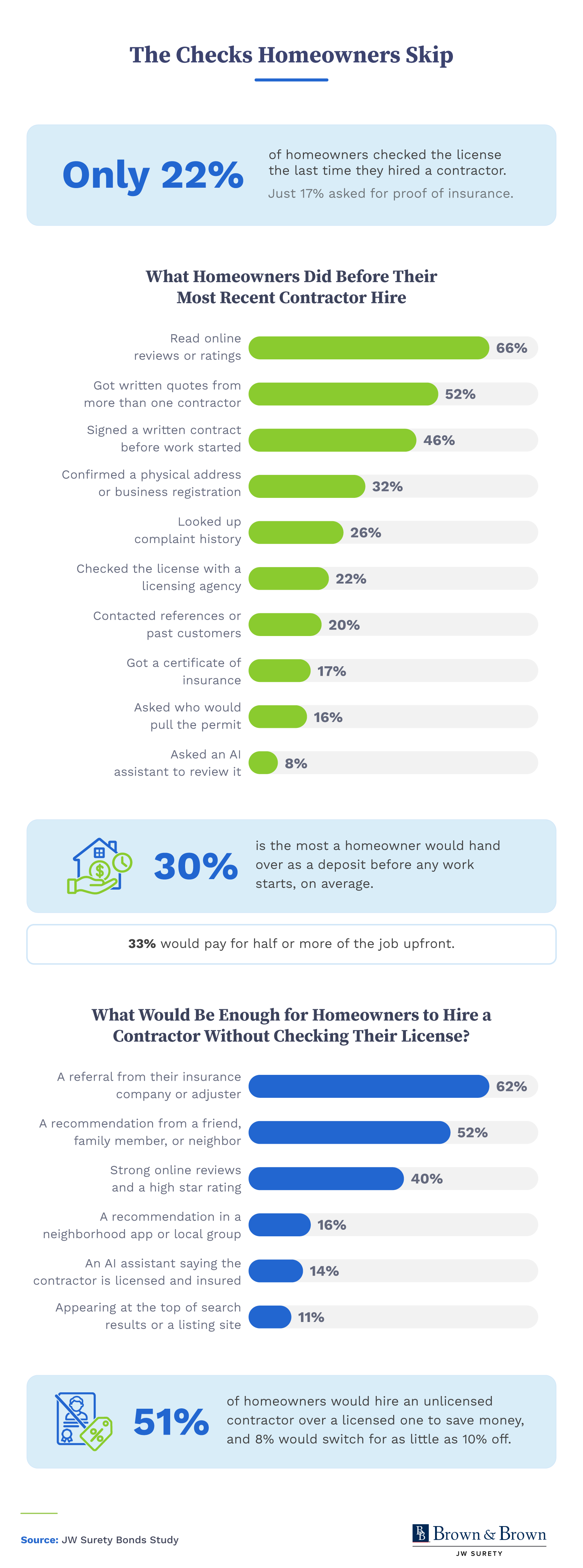
Most homeowners (61%) were confident they could spot a contractor scam, but only 22% said they checked a contractor's license before their most recent hire. Only 14% agreed that checking a license takes more effort than it's worth. Even more striking, 51% said they would knowingly hire an unlicensed contractor if doing so saved them money.
Homeowners were generally able to identify common warning signs. The most recognized red flags were:
- A contractor asking for the full cost in cash before starting (87%)
- Can't provide a license number when asked (84%)
- Offers only a verbal agreement, not a written contract (77%)
- Says the price is only available if you sign today (75%)
- Contractor with no physical business address (65%)
- Being asked to pull the permit in their own name (55%)
Technology may make evaluating contractors even more complicated. More than half of homeowners (51%) said AI makes it easier for dishonest contractors to appear legitimate, while only 26% thought AI makes it easier to tell dishonest and legitimate contractors apart.
Contractor Losses Can Be Difficult to Recover
A bad contractor experience can go beyond unfinished or poor-quality work. For many homeowners, it can mean losing thousands of dollars, with no guarantee that reporting the problem will bring that money back.
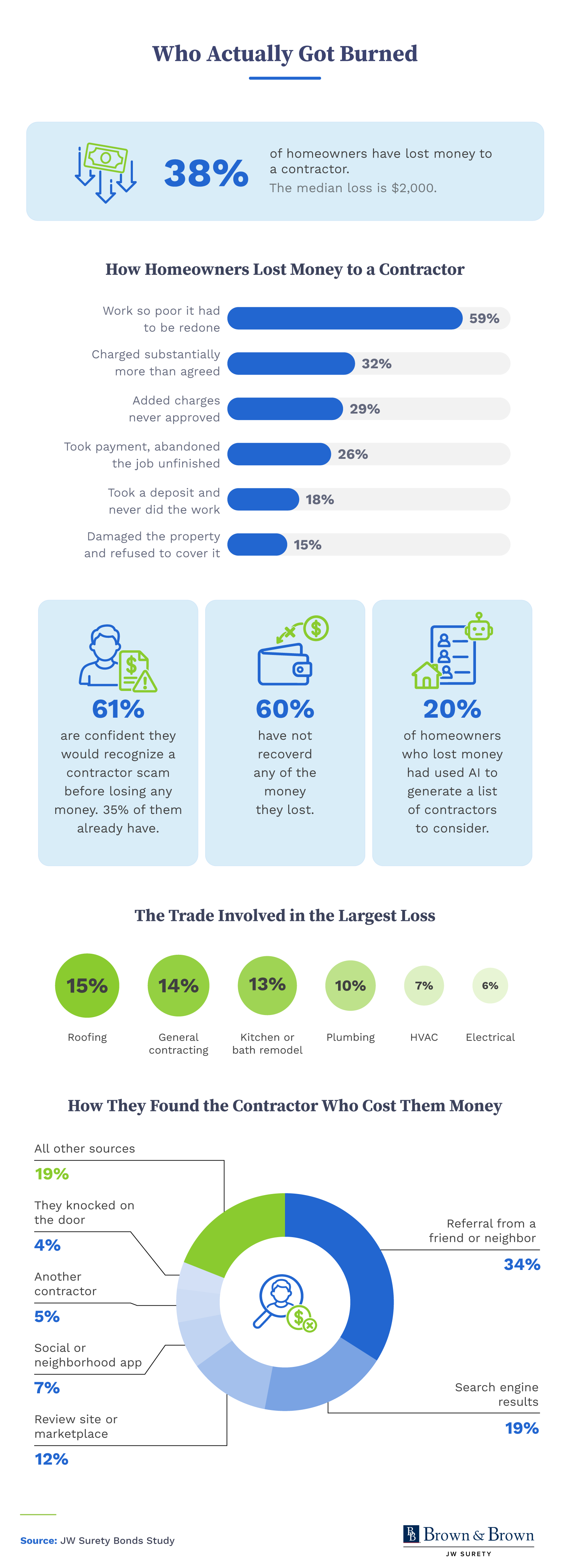
More than one-third of homeowners (38%) had lost money to a contractor. The median loss was $2,000, and 15% of victims had lost $10,000 or more. Recovering those losses proved difficult: 60% of contractor scam victims never recovered any of the money they lost.
Nearly half of homeowners who lost money (48%) never reported the incident to anyone. Among the 52% who did report their experience, 22% went to the Better Business Bureau, and 21% posted a public review or warning online. Only 13% contacted a state or local contractor licensing board.
AI has also become part of the home repair process for many homeowners, though its most common uses were informational rather than protective. Half of homeowners had used AI for something related to home repairs or contractors.
The most common uses were estimating the cost of a repair or project (29%) and diagnosing a problem before calling someone (28%). Only 11% had used AI to check whether a contractor or business was legitimate.
Protecting Your Home Starts Before the Work Does
Homeowners appeared to understand many of the warning signs associated with contractor scams, but awareness did not always translate into precautions. While 61% were confident they could identify a scam, only 22% checked a license before their most recent hire, and 51% were willing to knowingly hire an unlicensed contractor to save money.
Those decisions can carry significant financial consequences. More than one-third of homeowners had already lost money to a contractor, and most victims never recovered any of it. With AI creating new ways to research home repairs while also potentially helping dishonest contractors appear legitimate, basic vetting remains an important part of the hiring process.
Before signing an agreement or handing over money, the most valuable home repair decision may be taking the time to find out exactly who you're hiring.
Methodology
To find where Americans are most actively researching home repair scams, we measured Google search volume for contractor fraud and scam keywords across all 50 states, the District of Columbia, and the 100 most populous U.S. cities.
Search Interest
Total monthly search volume across keywords such as contractor scam, contractor fraud, contractor complaint, contractor lawsuit, contractor license lookup, unlicensed contractor, fake contractor, report a contractor, sue contractor, construction fraud, roofing scam, roofing fraud, HVAC scam, electrician scam, solar panel scam, pest control scam, and home warranty scam, summed across all terms and all 38 months from June 2023 through July 2026, then divided by resident population and expressed per 100,000 residents.
Higher search interest indicates homeowners actively researching contractor fraud, whether they are vetting a contractor before hiring, reporting one, or trying to recover after a loss. Figures are cumulative totals for the period, not annual rates. Search volumes are reported in increments of 10, so the smallest states and cities carry the widest margin of error. Source: Google monthly search volume; U.S. Census Bureau, September 2026.
Survey
We also surveyed 1,004 U.S. homeowners about how they vet contractors before hiring, how much they would pay upfront, whether they can identify contractor red flags, whether they have lost money to a contractor, how much they lost and recovered, whether they reported it, and how they use AI when dealing with home repairs. Respondents represented a mix of regions, genders, and generations across the country. The generational breakdown was 48% millennials, 31% Gen X, 14% baby boomers, and 7% Gen Z; 57% were women, and 42% were men. Data was collected in September 2026.
About JW Surety Bonds
JW Surety Bonds helps businesses and professionals across the U.S. meet their surety bond requirements with a simple online application process and access to experienced bond specialists. For contractors and other licensed professionals, we offer contractor license bonds to help meet state or local licensing requirements and provide financial protection when applicable.
Fair Use Statement
The information and findings in this article may be shared for noncommercial purposes only. When sharing these findings, please provide proper attribution and a link back to JW Surety Bonds.

Leave a Reply