


Every business owner learns the hard way at least once, and the first year is usually where it happens. We surveyed 300 U.S. small business owners about the money, legal, and operational decisions they most regret from year one, what those choices ended up costing, and what they wish they had done sooner. The answers point to a familiar set of early missteps that drained cash before owners caught them.
From underpricing and messy books to skipped contracts and wrong-fit clients, most of these mistakes came with a real price tag, and many owners are still paying it down. The patterns also show what the businesses that made it treated differently from the ones that struggled.
Key Takeaways
- Most owners (63%) say a first-year mistake cost them money, with the average hit reaching $5,630 and 19% losing more than $5,000.
- Underpricing is the No. 1 first-year regret (61%) and the single costliest decision owners name (41%).
- A third of business owners (33%) launch without a written contract, the most-skipped legal safeguard of year one.
- Nearly half of owners (49%) knowingly take on a wrong-fit client, and 86% of them say it costs them money, time, stress, or all three.
- More than four in 10 owners (42%) lean on AI for a decision they should have run by a professional, rising to 69% of Gen Z founders, with ChatGPT the most-used tool at 36%.
- Owners who call their business successful are far more likely to have had a written contract from day one (54% vs. 34%) and twice as likely to carry business insurance (50% vs. 25%).
The Anatomy of First-Year Regret
When owners look back on year one, the same handful of decisions keep coming up as the ones they would redo.
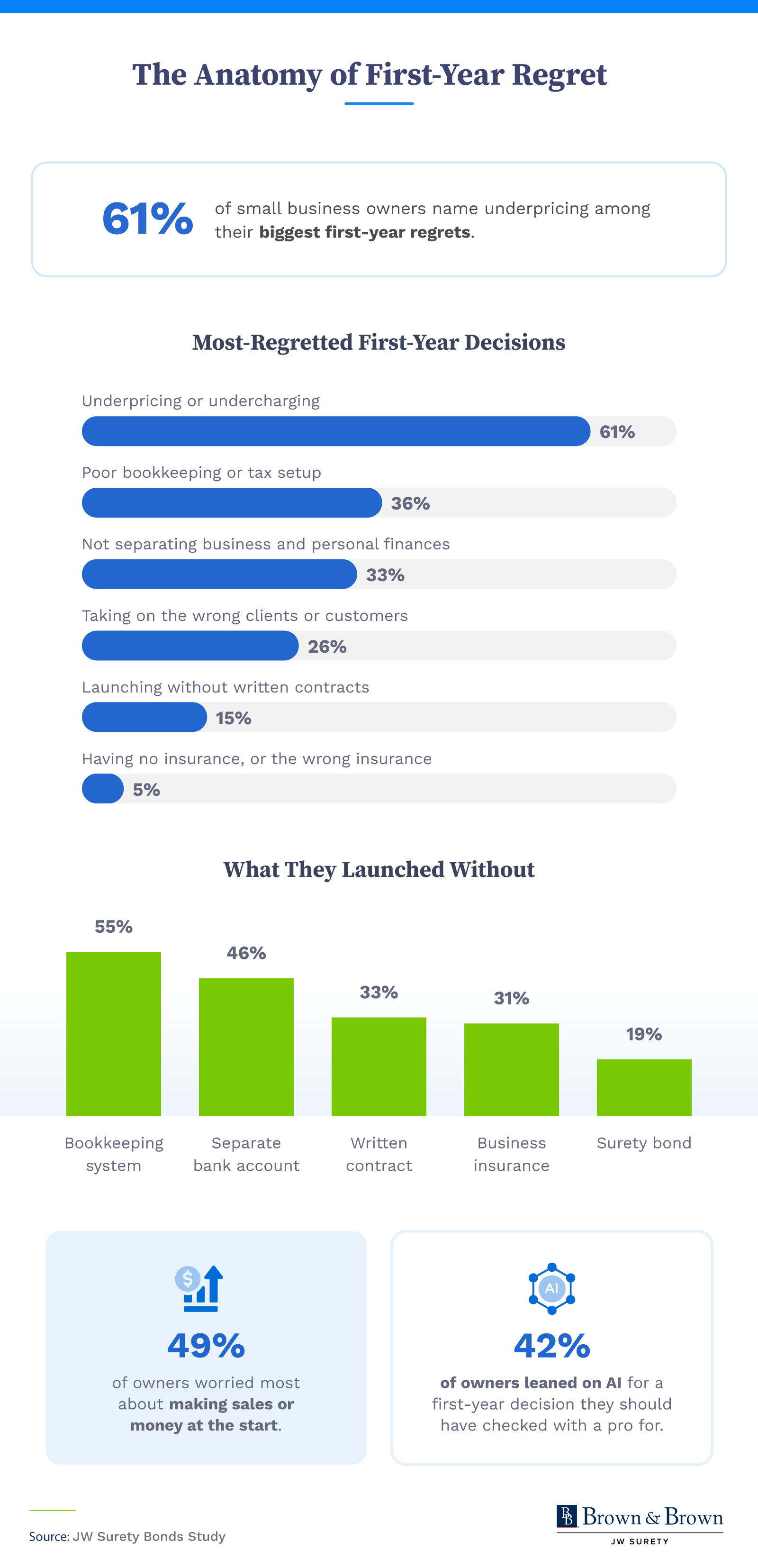
Underpricing sat at the top of the regret list, named by 61% of owners who wished they had charged more from the start. The pattern ran strongest among the youngest founders, at 69% of Gen Z and 64% of millennials, easing to 44% of baby boomers. Money missteps filled out the top three, with poor bookkeeping (36%) and mixing business and personal finances (33%) both landing ahead of any legal safeguard.
When owners did skip a formal protection, the written contract was the first to go (33%), followed by business insurance (31%) and the surety bond (19%). Cost was rarely the driver. Only 18% said they couldn't afford the protection, while 32% simply figured it didn't matter at their size, a perception gap that left plenty of new businesses exposed. Trades businesses were the most likely to open without a written contract (52%), compared with 31% in professional services.
A newer regret showed up in how owners made their calls. More than two-fifths of business owners (42%) turned to AI for a first-year decision they later felt they should have run by a professional, and that habit climbed sharply with youth, from 17% of baby boomers and 31% of Gen X to 45% of millennials and 69% of Gen Z. ChatGPT was the tool of choice at 36%, ahead of Google Gemini (19%) and Claude (15%).
What the Mistakes Actually Cost
The regrets weren't just uncomfortable in hindsight; they carried a measurable price.
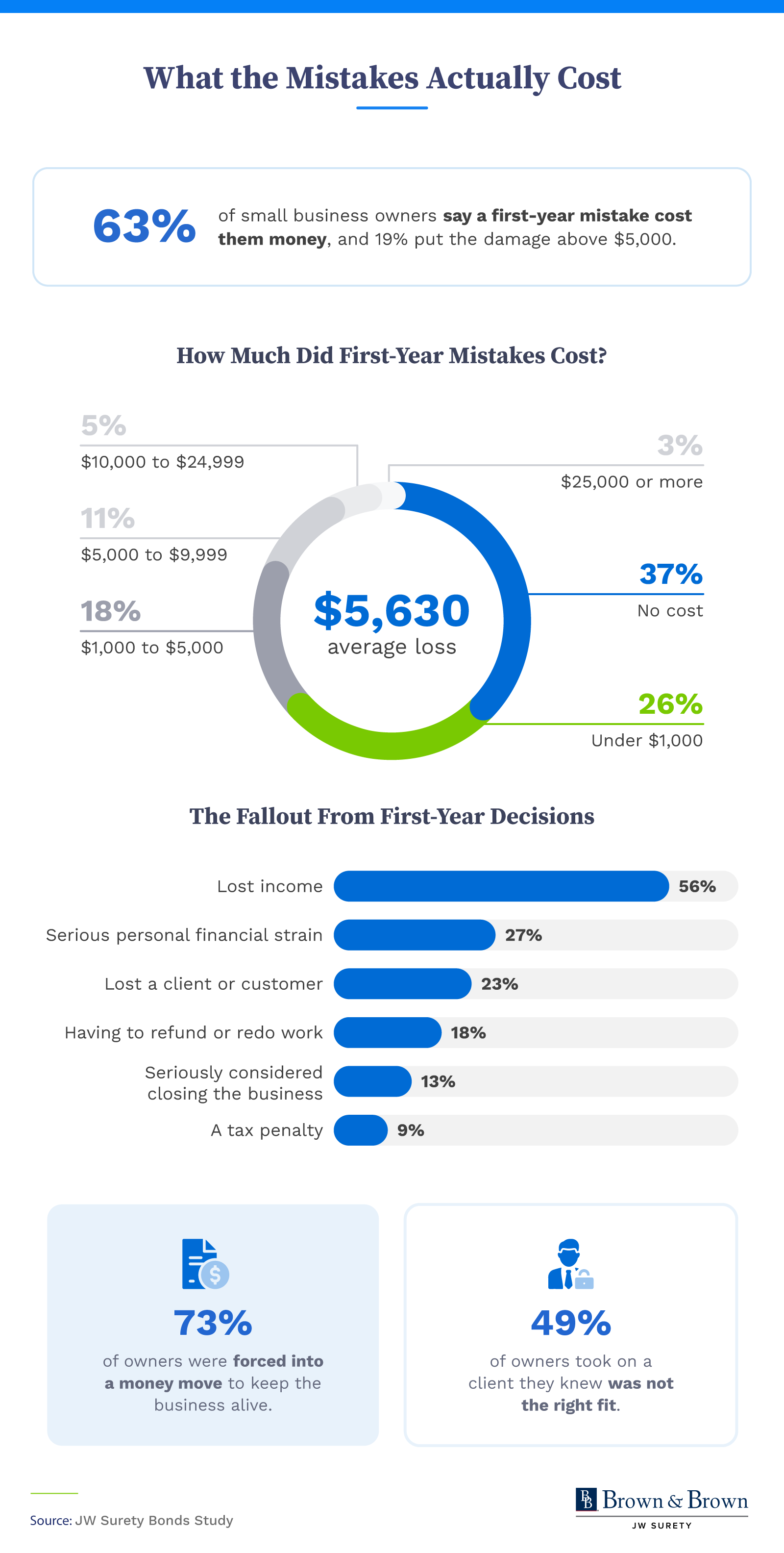 Underpricing didn't just top the regret list; it was also the single most expensive decision owners pointed to (41%), far ahead of poor bookkeeping (12%) and taking on the wrong clients (11%). Most who underpriced did it out of fear, with 53% holding their rates down because they worried about losing clients and 44% simply not knowing their worth or the going market rate. On average, owners stayed underpriced for about a year before correcting course, 82% undercharged at some point, and 13% say they still do.
The damage added up. Most owners (63%) lost money to a first-year mistake, 19% put the loss above $5,000, and the average hit landed around $5,630. Lost income was the most common fallout at 56%, and more than a quarter of owners (27%) reported serious personal financial strain. Experience offered little cushion here, as first-time founders (73%) and repeat founders (74%) were about equally likely to be pushed into a financial scramble.
To keep going, 73% of owners were forced into at least one money move, most often dipping into personal savings (45%), delaying their own pay (36%), or taking on credit card debt (30%). The pressure ran deep enough that 13% seriously considered closing, a figure that climbed to 17% among owners who had skipped a legal protection like a contract, license, insurance, or bond, vs. 9% among those who skipped none. Wrong-fit clients added to the strain. Nearly half of owners (49%) knowingly took one on, and 86% of them said it cost them financially, in time and stress, or both.
What the Survivors Did Differently
The owners who came through year one in good shape tended to get the unglamorous basics right early.
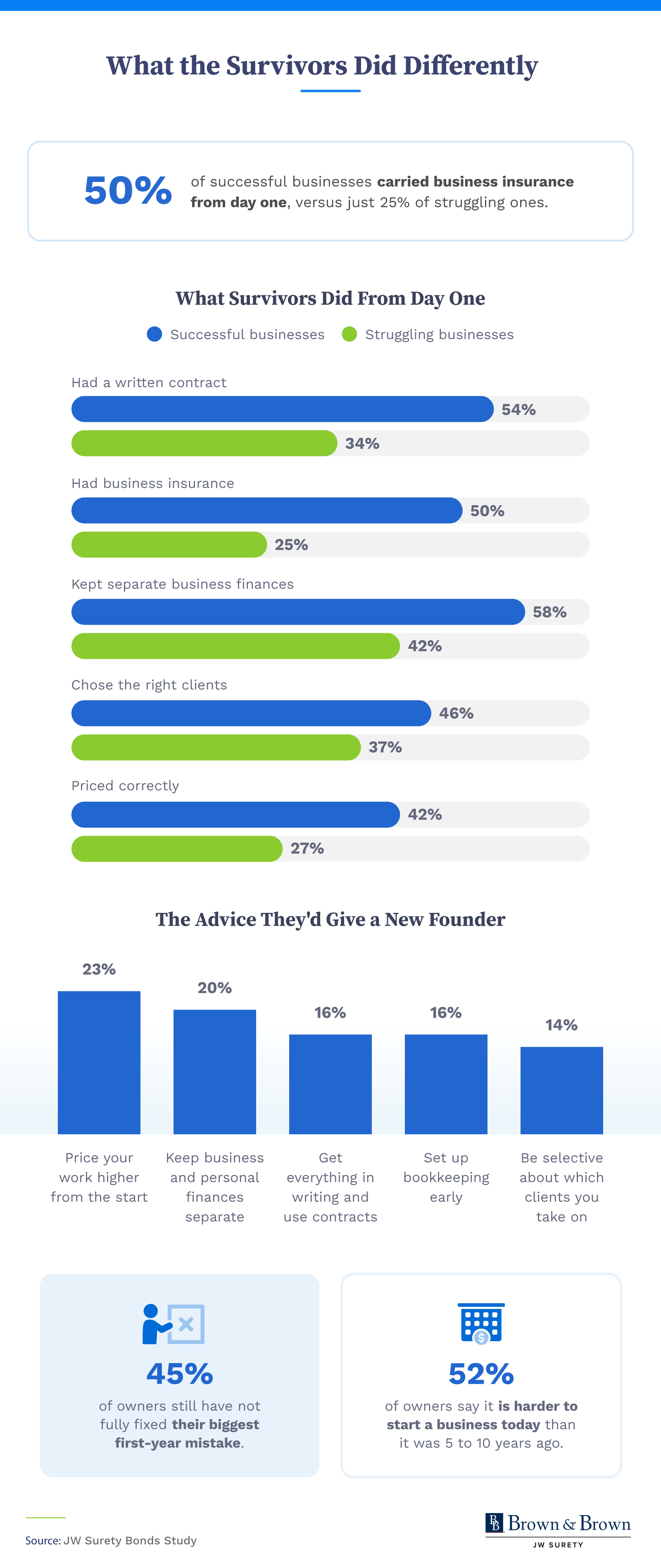
Owners who called their business successful were far more likely than struggling owners to have had a written contract from day one (54% vs. 34%) and twice as likely to carry business insurance (50% vs. 25%). They also more often kept separate business finances (58% vs. 42%) and chose the right clients (46% vs. 37%), the same safeguards struggling owners most often skipped.
Many owners are still living with their early mistakes, with 45% saying they have not fully fixed their biggest first-year misstep (38% partly resolved, 7% not at all). That exposure fell hardest on the strugglers, as 68% of struggling owners still hadn't fully fixed it, compared with just 17% of successful ones.
Asked what they would tell a new owner, the most common piece of advice mirrored the No. 1 regret: price your work higher from the start (23%). The next tips were protective by nature, with 20% urging owners to keep finances separate and 16% to get everything in writing. That caution fits the mood of the moment, since 52% of owners believed it is harder to start a business today than it was five to 10 years ago, which was a view shared across Gen X (57%), Gen Z (56%), and millennials (50%), and felt most by first-time founders (56% vs. 44% of repeat founders).
The Cheapest Fixes Come Before the Mistake
The through-line across year one is that the most expensive mistakes were also the most avoidable. Owners lost money less often to bad luck than to underpricing, loose paperwork, and protections they assumed they didn't need yet, and the ones who fared best treated contracts, clean books, and insurance as starting costs rather than someday upgrades. If you're early in your own first year, the cheapest fixes tend to be the ones you make before a mistake has a price tag. Charging what your work is worth and getting the basics in writing won't guarantee smooth sailing, but the owners who did both had far less to undo later.
Methodology
JW Surety Bonds surveyed 300 U.S. small business owners in July 2026 through an online questionnaire fielded via CloudResearch Connect. All respondents were adults 18 or older. Respondents reflected on the financial, legal, and operational decisions from their first year in business, including the mistakes they most regret, what those mistakes cost, and the steps they wish they had taken sooner. Only complete responses tied to a unique respondent ID were included in the analysis.
Reported age was grouped into generations for analysis: Gen Z (18 to 29), millennials (30 to 45), Gen X (46 to 61), and baby boomers (62 and older). The sample skewed toward millennials (54%) and Gen X (30%), with solo operators making up 65% of respondents.
For questions allowing more than one answer, percentages are based on the total number of respondents. For the open-ended dollar-cost question, averages are reported both with all valid numeric responses and after removing statistical outliers using the interquartile range method. Demographic breakdowns are shown only for subgroups representing at least 5% of respondents, and all figures are rounded to the nearest whole percentage.
As a self-reported survey based on first-year recall, responses reflect the perceptions and estimates of the business owners surveyed.
About JW Surety Bonds
JW Surety Bonds is the leading writer of Surety Bonds in the U.S., helping business owners meet the legal and financial requirements that protect their customers and their companies. Because so many of the owners we surveyed skipped early safeguards, we make it straightforward to get the right coverage from the start, from Contract Bonds and License Bonds to the Commercial Insurance many new businesses overlook. Our in-house claims team and easy online platform help owners get bonded quickly and stay compliant with state and federal rules.
Fair Use Statement
We welcome the noncommercial sharing of these findings. If you reference the data, please attribute JW Surety Bonds with a link back to this page so your audience can review the full study and its methodology.

Leave a Reply