

Skilled trades are experiencing a surge in new business creation, fueled by rising demand, population shifts, and accessible entry points for entrepreneurs. Using U.S. Census Bureau business formation data and Bureau of Labor Statistics projections, this analysis by JW Surety Bonds identified which trades are growing fastest and where skilled trade entrepreneurship is expanding most quickly.
The findings also showed how many of these fast-growing businesses are entering regulated industries where licensing and bonding are part of the startup process. For aspiring business owners, these trends offer a clearer picture of where opportunity is building in 2026.
Key Takeaways
-
Roofing is the fastest-growing skilled trade in America, with 26% growth over five years.
-
Between 2018 and 2023, 65,490 new skilled trade firms opened, with 9,454 launching in 2023 alone.
-
Idaho leads all states with a 30% growth in skilled trade establishments, followed by Utah at 27.2% and Arizona at 23.9%.
-
Florida is accelerating faster than any state year over year, adding 4% more skilled trade firms in the most recent year alone, followed byArizona (3.8%) and Arkansas (3.7%).
-
The Sun Belt's skilled trade economy is growing 3.5 times faster than the Rust Belt, with an average establishment growth of 18% versus 5.2%.
Which Skilled Trades Are Growing Fastest?
Some skilled trades added firms at a remarkable pace, while others grew more slowly or even lost momentum. The biggest opportunities appeared in trades that combined strong demand with relatively accessible paths to business ownership.
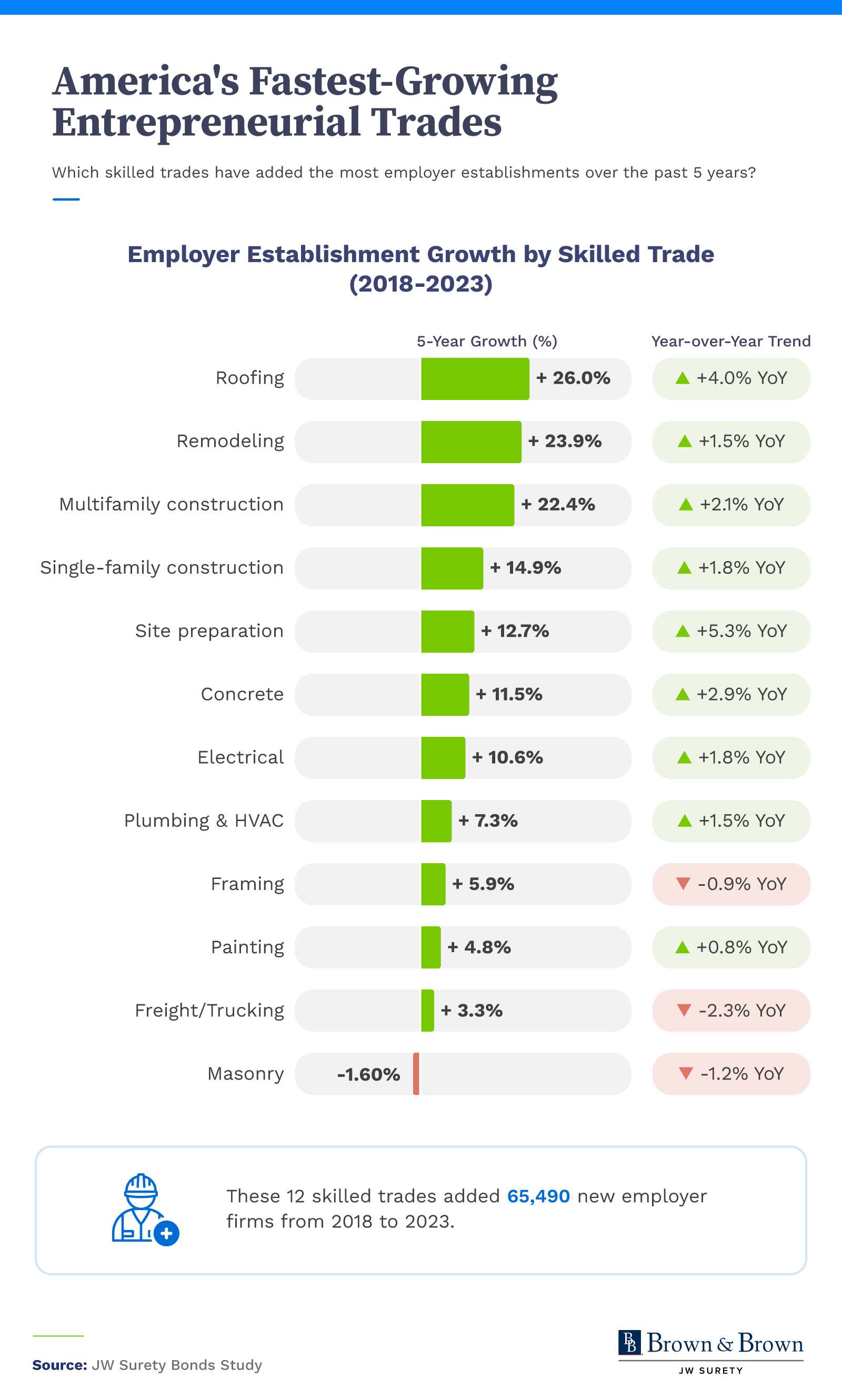
Roofing posted the fastest five-year growth at 26%, making it the top trade for entrepreneurial expansion. Remodeling followed at 23.9% and added 26,147 new firms since 2018, more than electrical, plumbing, and roofing combined. Multifamily construction also grew 22.4%, while single-family construction rose 14.9%, showing continued strength in housing-related trades.
Site preparation stood out as the fastest-accelerating trade year over year at 5.3%, a sign that construction pipelines were continuing to fill. Concrete grew 11.5%, and electrical increased 10.6%, pointing to steady demand across multiple project phases. At the other end of the spectrum, masonry declined 1.6%, while framing and freight lost year-over-year momentum.
Firm size also helped explain where new business ownership was taking hold. Microfirms with fewer than five employees grew 21%, compared to 9% for larger firms, making them 2.3 times faster-growing. The average remodeling firm had just 3.5 employees, the smallest of any skilled trade, which made it one of the most accessible starting points for first-time entrepreneurs.
The trade startup pipeline remained active throughout the study period. A total of 65,490 new skilled trade firms opened between 2018 and 2023, and 9,454 opened in 2023 alone. That worked out to 13,098 new firms per year on average, or about 36 new trade businesses launching every day.
Many of the fastest-growing trades were also among the most bond-dependent. Roofing, remodeling, and electrical commonly require contractor license bonds in most states, meaning many first-time owners in these sectors must navigate bonding requirements before they can legally operate.
Where Trade Business Growth Is Concentrated
Growth was not spread evenly across the country. The strongest momentum appeared in states benefiting from population growth, construction demand, and expanding small-business activity.
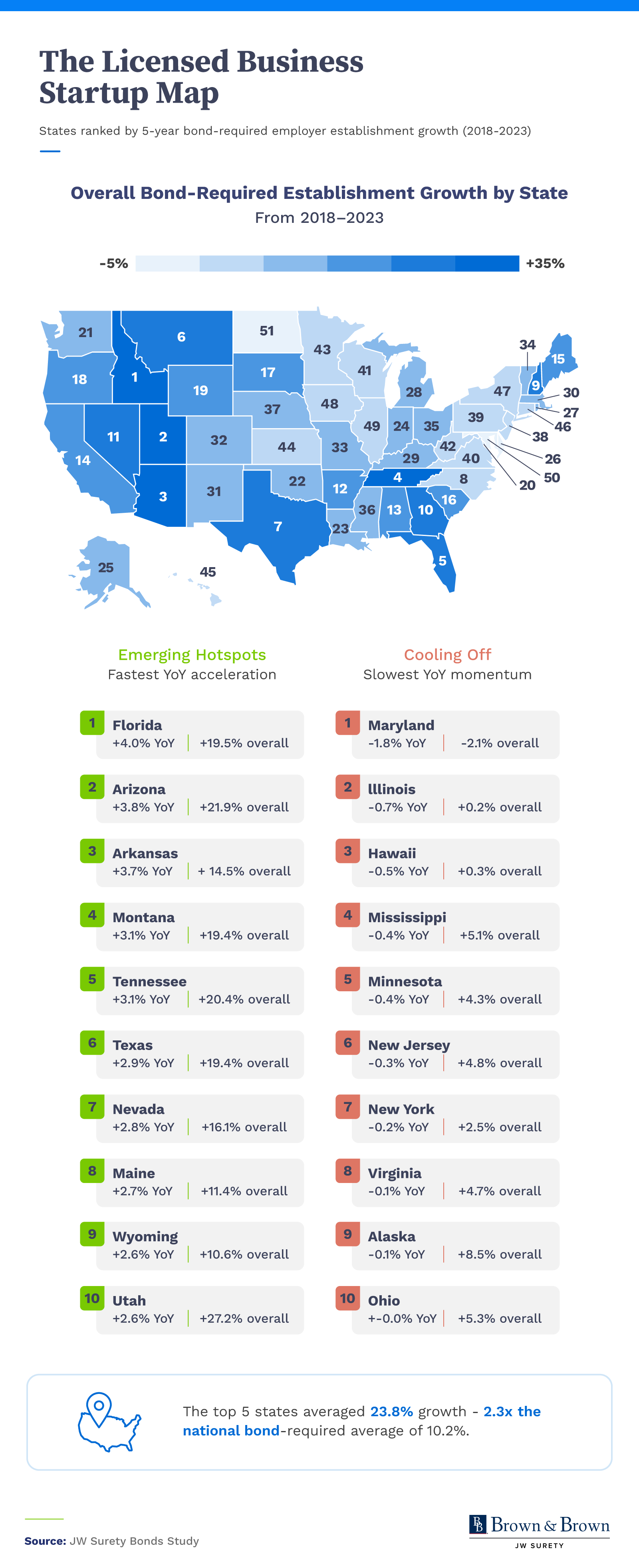
Idaho led all states with a 30% skilled trade establishment growth, followed by Utah at 27.2% and Arizona at 23.9%. Idaho also ranked fourth in per-capita density at 385.4 firms per 100,000 residents, making it both the fastest-growing and one of the most entrepreneur-saturated states in the country.
The Sun Belt's skilled trade economy grew 18% on average, compared to 5.2% in the Rust Belt. That means the Sun Belt expanded 3.5 times faster, closely mirroring broader population migration patterns. Florida, California, and Texas alone added 24,762 firms, accounting for 38% of all new skilled trade businesses.
Momentum also shifted sharply on a year-over-year basis. Florida accelerated the fastest, adding 4% more skilled trade firms in the most recent year alone, followed by Arizona at 3.8% and Arkansas at 3.7%. These gains suggested that business formation was still picking up speed in many high-growth states.
Nearly every state saw overall expansion from 2018 to 2023. A total of 49 out of 51 states grew during that period, while North Dakota declined by 2.4% and Maryland declined by 2.1%. For entrepreneurs considering where to launch, the data showed that regional demand and migration trends played a major role in shaping opportunity.
The Road Ahead for Skilled Trade Businesses
America's skilled trade economy is expanding quickly, with growth led by roofing, remodeling, and other trades that offer strong demand and accessible entry points for entrepreneurs. Much of that momentum is coming from microbusinesses and first-time owners launching in states where population and construction activity are rising fastest.
At the same time, many of these businesses are entering regulated industries where licensing and bonding are part of getting started. For anyone exploring a trade-based business, understanding both the growth trends and the compliance requirements can help build a stronger path forward.
Methodology
To determine America's fastest-growing entrepreneurial trades and the states where skilled trade businesses are expanding fastest, we analyzed employer establishment data from the U.S. Census Bureau County Business Patterns (CBP) database across 17 six-digit NAICS codes spanning four bond-required industry groups.
The data sources included:
- Employer establishment counts by state and 6-digit NAICS code from the U.S. Census Bureau County Business Patterns (2018-2023)
- Median annual wages by occupation from the U.S. Bureau of Labor Statistics Occupational Employment and Wage Statistics (May 2024)
- Business application counts by sector from the U.S. Census Bureau Business Formation Statistics (2018-2025)
- State population estimates from the U.S. Census Bureau Population Estimates Program (2023)
Here are the industries that were analyzed:
This study covered 12 skilled trades across four bond-required industry groups: Building Construction (NAICS 2361), Specialty Trade Contractors (NAICS 2381-2389), Freight Brokerage (NAICS 4885), and Auto Dealers (NAICS 4411-4412). All industries analyzed require surety bonds in most U.S. states to legally operate.
The metrics included:
- 5-year establishment growth: Percentage change in employer establishments from 2018 to 202.
- Year-over-year (YoY) growth: Percentage change from 2022 to 2023.
- Per-capita rates: Establishments per 100,000 residents using 2023 Census population estimates.
- Firm size: Average employees per establishment calculated from CBP employment and establishment counts.
The limitations of the study are as follows:
CBP measures employer establishments only, meaning businesses with at least one paid employee. Non-employer firms (sole proprietors with no employees) are excluded, which may undercount trades like painting and framing where solo operators are common. Establishment counts reflect physical locations, so a single company with multiple job sites may appear as one establishment.
Growth rates reflect net changes, not gross openings and closures. YoY trends are based on a single year (2022-2023) and may not represent sustained momentum. Wage data from BLS OEWS covers broad occupational categories and may not precisely align with 6-digit NAICS industry definitions. State-level bonding requirements vary, and not all firms in these NAICS codes necessarily hold surety bonds, though the majority in construction, freight, and auto dealing do.
About JW Surety Bonds
JW Surety Bonds is among the nation's leading surety bond providers, supporting contractors, trade professionals, and small business owners in staying compliant and protected. From construction bonds to electrical contractor bonds, our team simplifies federal and state requirements so you can focus on growing your business.
Fair Use Statement
Information from this article may be shared for noncommercial purposes only. Please include a link with proper attribution to JW Surety Bonds when citing or referencing this content.

Leave a Reply